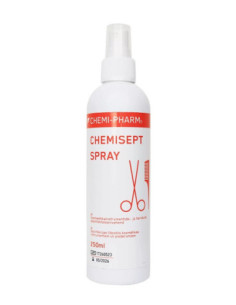
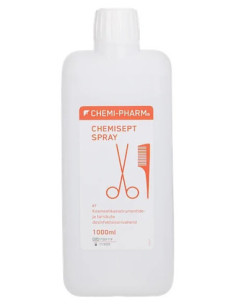
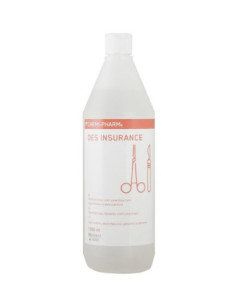
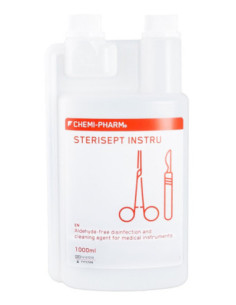
Instrument disinfectants for professional salon hygiene
Instrument disinfectants are designed for hygiene routines involving reusable tools in hair salons, barbershops, beauty salons, nail studios, pedicure practices, spas and other professional environments. The category covers products intended for disinfecting instruments, tools and accessories and, where the individual product allows it, certain work surfaces. Their role is to support a consistent process between clients and to help professionals choose a treatment method that matches the tool, material and intended use.
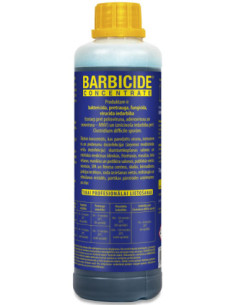
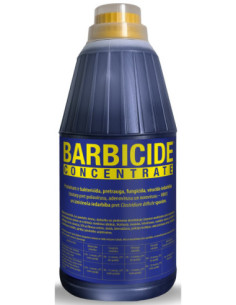
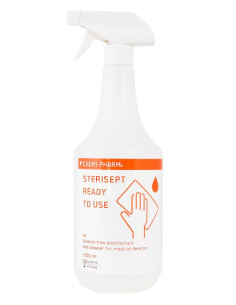
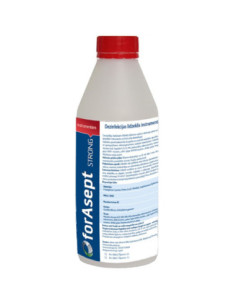
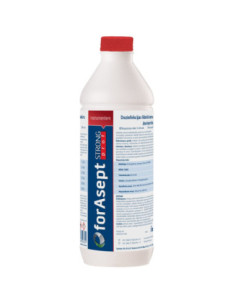
The range may include concentrates and other professional disinfection formats, with brands such as Barbicide, Chemi-farm and Forasept associated with the category. Product instructions remain decisive: dilution, contact time, antimicrobial spectrum, material compatibility, rinsing requirements and permitted applications vary from one formula to another. Biocidal products should always be used according to the label and manufacturer information.
Which salon tools may need instrument disinfection?
Common examples include scissors, combs, brushes, tweezers, manicure and pedicure tools, removable clipper or trimmer parts, drill bits, cosmetic instruments and similar reusable accessories. However, “instrument disinfectant” is not a universal permission to treat every item in the same way. A product may be suitable for stainless steel but not for a particular plastic, rubber, acrylic or coated surface. Always check the stated material compatibility before immersion or spraying.
It is equally important to distinguish instrument disinfection from hand antisepsis and general surface cleaning. A hand disinfectant is formulated for skin and should not automatically be used on tools. A surface spray may be useful for counters or treatment furniture yet not be intended for soaking scissors or nail instruments. The label should clearly support the intended application.
Concentrated disinfectant, ready-to-use liquid or spray
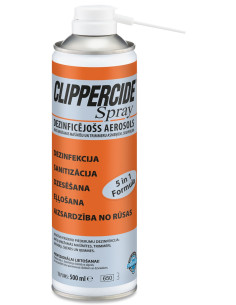
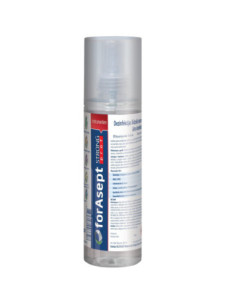
Professional instrument disinfectants are commonly sold as concentrates, ready-to-use liquids or sprays. A concentrate is diluted with water to a specified working concentration. It can be efficient for busy salons because one bottle can produce a larger volume of working solution, but accurate measuring is essential. Ready-to-use products remove the dilution step and can simplify routine handling. Sprays may be practical for selected tools, attachments or surfaces when the manufacturer specifically permits spray application.
When comparing formats, think about daily tool turnover, the volume of solution you need, whether tools are immersed in a disinfection jar, the available storage space and how easily staff can follow the required procedure. The most convenient product is the one that fits the actual workflow while still meeting its labelled conditions of use.
How to choose a disinfectant for salon instruments
Start with intended use. Check whether the product is designed for hairdressing tools, barber equipment, manicure or pedicure instruments, cosmetic tools or a wider set of professional accessories. Next, compare dilution, required contact time, material compatibility and application method. For concentrates, package size alone does not show value: the stated dilution determines how much working solution can be prepared.
Professionals working with metal instruments should pay particular attention to corrosion compatibility and to any restrictions around prolonged soaking. For plastic, acrylic, glass, rubber or mixed-material tools, check the exact material guidance. If an ultrasonic cleaner forms part of the workflow, use only a disinfectant that is explicitly suitable for that device and follow both the cleaner and chemical manufacturer instructions.
Cleaning, disinfection and sterilisation are different processes
Cleaning removes visible contamination and residues. Disinfection aims to reduce or inactivate microorganisms according to the tested and declared performance of the specific product. Sterilisation is a separate process with a different objective and should not be treated as interchangeable with chemical disinfection. This distinction matters particularly for tools used in procedures where local hygiene rules may require additional reprocessing steps.
In practice, instruments normally need to be visibly clean before the disinfection stage can work as intended. Depending on the product, tools may need to be rinsed after the required contact time and then dried thoroughly. Follow the product directions rather than relying on a generic routine, because different formulations may have different preparation, immersion and after-treatment requirements.
Working solution, contact time and disinfection containers
For concentrated products, the working solution must be mixed accurately. A weaker mixture may not meet the labelled conditions, while using more chemical than specified is not automatically safer or more effective. Contact time is equally important. Where immersion is required, the relevant parts of the instrument should remain fully exposed to the solution for the stated period.
A dedicated disinfection container can make daily routines easier. Small manicure jars are practical for tweezers, nippers or small attachments, while longer scissors and combs require a container that allows proper placement. Baskets or strainers can make removal more hygienic and reduce unnecessary hand contact. The solution should be renewed according to the manufacturer’s directions and sooner if the instructions require replacement after contamination.
Hair salons, barbers, nail technicians and beauty professionals
Different professions create different tool-disinfection needs. Hairdressers commonly handle scissors, combs and brushes; barbers may also need routines for clipper attachments, trimmers and shaving accessories. Nail professionals work with nippers, pushers, scissors, files and drill bits, while beauty and pedicure specialists can use a broader range of reusable instruments. That is why the right product should be selected around the actual instrument set, not simply around a familiar brand name.
Where a salon uses several types of tools, a clearly documented process can reduce mistakes: remove visible debris, apply the correct cleaning step, prepare the disinfectant at the labelled concentration, observe the required contact time, rinse if instructed, dry completely and continue with any further reprocessing required for that instrument.
What to check before buying
Before ordering an instrument disinfectant, verify the intended use, product format, dilution or ready-to-use status, contact time, material compatibility, container requirements and whether rinsing is necessary. Also consider how much working solution the salon realistically uses and whether the chosen package size suits the workload.
A well-chosen disinfectant supports a reliable hygiene routine without making the process unnecessarily complicated. For professional salon use, the most useful product is one whose instructions match the tools, materials and workflow in your business. Read the label carefully, follow the stated dosage and contact time, and combine disinfection with appropriate cleaning, drying and sterilisation where required.