Disinfection and cleanliness for salons and beauty professionals
Professional disinfection and cleanliness products support the daily hygiene routine of hair salons, barbershops, nail studios, beauty rooms, spas and other professional workspaces. This category covers solutions for reusable tools, hard surfaces, workstations and commonly touched areas, together with cleaning products and accessories that help keep hygiene procedures organised between clients. The aim is not simply to make a salon look clean: it is to choose the right process for the item being treated and to follow the product label, contact time and material-compatibility instructions.
Cleaning, disinfection and sterilisation describe different stages. Cleaning removes visible soil and residues. Disinfection uses an appropriate product and process to reduce or inactivate microorganisms according to the stated efficacy of that product. Sterilisation is a separate, higher-level process required for certain instruments and procedures. A disinfectant therefore should not automatically be treated as a substitute for sterilisation, particularly for instruments associated with procedures that can break the skin.
Disinfectants for salon tools and reusable instruments
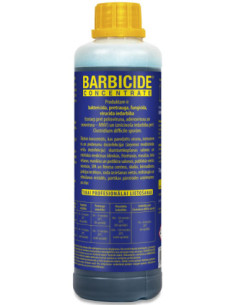
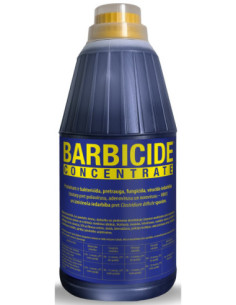
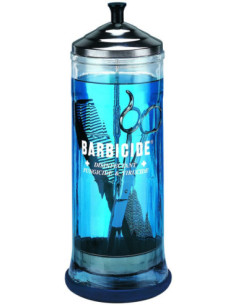
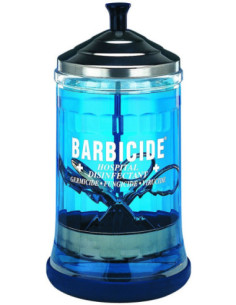
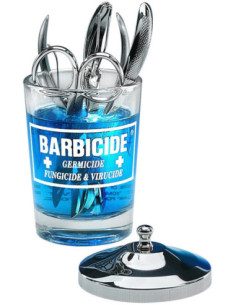
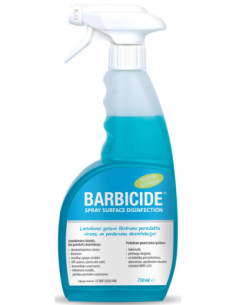
Tool disinfectants are commonly selected for combs, shears, clips, some clipper components, tweezers and other reusable implements when the manufacturer of the implement permits chemical disinfection. Products may be supplied as ready-to-use sprays or as concentrates that must be diluted to a specified working solution. SalonLine currently lists professional tool-disinfection formats including concentrates, ready-to-use sprays and dedicated soaking containers, with BARBICIDE and ForAsept represented in the range.
For immersion disinfection, the implement should be suitable for soaking and the disinfectant solution should be prepared exactly as directed. A dedicated container can help keep instruments fully covered during the required exposure time and can make the routine easier to standardise across a team. For tools that should not be immersed, a spray or wipe may be more suitable if the product label and the tool manufacturer allow that method.
Surface disinfectants for workstations, chairs and equipment
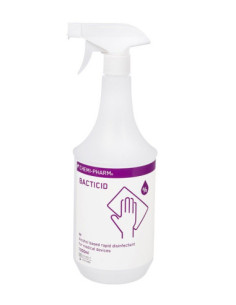
Surface disinfection is used on compatible hard surfaces such as worktops, trolley handles, chair components, treatment-bed surfaces, equipment housings and other touchpoints. Ready-to-use sprays and disinfectant wipes are useful where a fast, repeatable reset is needed between appointments. Concentrates can suit larger areas or higher-volume professional use, provided dilution is accurate and staff follow the specified contact time.
Visible contamination should normally be removed before disinfection because dirt and organic matter can interfere with the performance of a disinfectant. The treated area must also remain sufficiently wet for the stated contact time. Product labels matter: an alcohol-based formula may work well on many alcohol-resistant hard surfaces but may be unsuitable for particular plastics, acrylics, coatings or sensitive finishes.
Cleaning products and disinfection are not interchangeable
Salon cleanliness also depends on routine cleaning. Shampoos, styling products, nail dust, skin oils, hair fragments and general soil are physical residues that may need to be removed before a disinfectant can do its job effectively. A cleaner is designed primarily to remove soil; a disinfectant is intended to control microorganisms. Some professional products combine cleaning and disinfecting properties, but this should only be assumed when the manufacturer explicitly states both functions.
Wipes, sprays, surface cleaners, soaking containers and dispensing accessories can therefore complement one another. The most practical setup is usually a small, clearly defined system in which every product has a known purpose rather than one chemical being used for every task.
How to choose the right salon disinfectant
- Intended use: check whether the product is for instruments, hard surfaces, hands, skin or a specific type of equipment.
- Ready to use or concentrate: ready-to-use formats reduce preparation steps; concentrates can be economical for regular professional use but require precise dilution.
- Contact time: compare how long the treated item or surface must remain in contact with the working solution to achieve the stated efficacy.
- Material compatibility: confirm suitability for stainless steel, plastics, acrylic, rubber, glass or other materials you actually use.
- Application method: decide whether immersion, wiping or spraying fits the item and the salon workflow.
- Safety and storage: read the label, hazard information and storage instructions, and use personal protective equipment where required.
Disinfection versus sterilisation
One of the most important buying questions is whether the task requires disinfection alone or a full reprocessing sequence that ends with sterilisation. For lower-risk non-invasive items, cleaning and appropriate disinfection may be the relevant steps. For instruments used in procedures where the skin can be broken, local rules may require additional decontamination and sterilisation. UV cabinets and ultrasonic cleaners should not be assumed to provide sterilisation simply because they are associated with instrument care. Ultrasonic cleaning can support cleaning workflows, while sterilisation requires an appropriate validated process.
Choosing formats for different professional routines
A busy barbershop may prioritise fast treatment of workstation touchpoints, clipper-related accessories and combs. A nail technician may need a clearly separated process for reusable metal tools, cleaning and subsequent sterilisation where required. A beauty therapist may need surface products compatible with treatment beds, trolleys and device housings. In each case, the useful search question is not “which disinfectant is strongest?” but “which product is approved for this object, material and process, and what preparation and contact time does it require?”
What to compare before ordering
Compare pack size, working-solution yield, application format, contact time, material compatibility and whether rinsing is required after treatment. For concentrates, calculate how much usable solution the package makes rather than comparing bottle size alone. For ready-to-use sprays and wipes, consider convenience and how frequently the product will be used between clients. If you use disinfecting jars or soaking containers, choose a size that allows the relevant part of the implement to be adequately immersed without overcrowding.
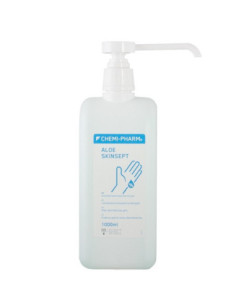
Brands such as BARBICIDE, Chemi-Pharm and ForAsept are associated with professional hygiene and disinfection products, but individual formulas differ. Always make the final choice from the specific product label and instructions rather than relying on the brand name alone.
A clear hygiene system for a professional salon
A well-designed salon hygiene routine is simple to understand and repeat: remove visible soil, select the correct product, apply the correct concentration, keep the surface wet or the tool immersed for the required time, rinse or dry if instructed, and continue to sterilisation when the procedure requires it. By selecting disinfection and cleaning products according to their actual purpose, SalonLine customers can build a practical system for tools, surfaces and everyday workstation cleanliness without confusing cleaning, disinfection and sterilisation.